


Table of Contents
- What’s Trending in Floral Design for 2026
- Flowers in Season 2026: What’s Available Each Month
- Color Palettes and Design Aesthetics Leading 2026
- Trending Flower Varieties and Botanical Elements
- Arrangement Styles Gaining Momentum in 2026
- How to Make Cut Flowers Last Longer
- Seasonal Flowers by Month: A Quick Reference
- Frequently Asked Questions
Last Updated: October 13, 2026
What’s Trending in Floral Design for 2026
The floral design world is shifting from polished, uniform arrangements toward designs that feel intentional, textured, and connected to nature.
This year’s seasonal flower trends emphasize texture, organic shapes, and palettes mixing earth tones and soft pastels with bold, saturated colors.
The 2026 trends break into four categories: color direction, botanical choices, arrangement aesthetics, and preserved elements.
Flowers in Season 2026: What’s Available Each Month
Knowing what’s available each month changes everything, work with what nature gives you and look better for it.
Spring Blooms (March-May)
Spring brings renewal and softness. Hyacinth and spider gerberas peak now, offering drama and texture, while versatile dianthus works in everything from wildflower arrangements to structured bouquets.
Spring is the season for pastels: buttercream, vanilla, and apricot tones mixed with whites and pale greens.
Locally grown spring flowers reduce cost and environmental impact. Spring blooms last 7-10 days with proper care.
Summer Selection (June-August)
Summer is where color explodes. Butter-yellow blooms dominate trending palettes, with deep, saturated colors gaining ground. Wildflower and meadow-style arrangements hit their stride because the sheer variety available makes them look effortless.
Soft, fluffy grasses peak now: pampas grass, dried palms, and other textural elements become affordable. Lean into the texture-and-volume trend, arrangements that feel dimensional and organic rather than tightly structured.
Fall and Autumn Picks (September-November)
Autumn brings earth tones and warm neutrals into focus, when the earthy luxe palette, deep burgundies, rust, ochre, and chocolate browns, dominates.
Fall flowers have excellent longevity, many last 10-14 days in a vase, making them practical for events.
Fall is perfect for combining fresh flowers with preserved elements; the contrast creates visual interest and aligns with the 2026 trend of mixing textures and materials.
Winter Varieties (December-February)
Winter is all about structural shapes and preserved botanicals.
Winter arrangements rely heavily on preserved elements: dried palms, preserved moss, and repurposed botanicals. The aesthetic leans toward dramatic, sculptural installations that use form rather than flower count.
Cooler temperatures extend vase life: arrangements can last 2-3 weeks or longer, making winter florals practical for long-term displays and events (pubmed.ncbi.nlm.nih.gov).
Color Palettes and Design Aesthetics Leading 2026
Color direction drives design decisions more than ever. The 2026 trends break into three palettes: earthy luxe, romantic pastels, and bold modern.
These predictions follow a mix of signals, what growers are planting, what designers are requesting, and broader consumer color preferences, rather than a single authoritative forecast.
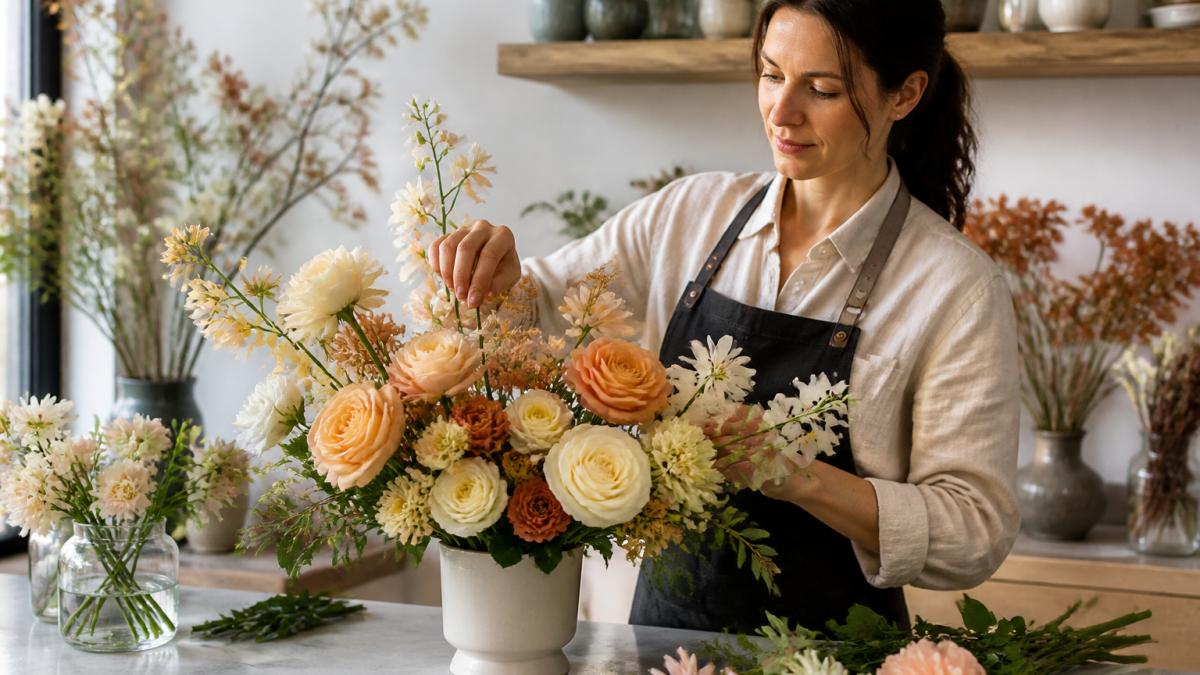
Earthy Luxe
Warm neutrals, taupes, creams, warm grays, grounded by deep earth tones like rust, burgundy, and chocolate. Sophisticated and timeless, it’s trending in wedding florals and corporate events because it photographs beautifully and appeals across age groups.
- Flowers that deliver it: chrysanthemums and celosia in rust and bronze, hypericum berries, preserved hydrangeas, amaryllis in deep red, and garden roses in caramel and terracotta tones.
- Peak season: strongest from September through February, when autumn and winter varieties naturally carry these tones.
- Mechanic: build the arrangement on a neutral base (cream or taupe blooms) and place the deep tones low and central so they anchor rather than dominate.
Romantic Pastels
Soft, uplifting tones, blush, lavender, soft peach, and pale yellow, paired with whites and sage greens. Nostalgic and whimsical, it connects to the broader retro and vintage-inspired design trend.
- Flowers that deliver it: ranunculus, hyacinth, sweet pea, lisianthus, and garden roses in blush and peach, with sage-toned foliage such as eucalyptus.
- Peak season: spring and early summer, when these varieties are at their best and most affordable.
- Mechanic: keep contrast low. Pastels work when the value range is narrow; adding one deep tone can sharpen the arrangement, but two or more will muddy it.
Bold Modern
Saturated, vivid color, deep jewel tones, vibrant magentas, electric blues, and the trending butter-yellow. These arrangements make a statement, used either in single-color monochromatic designs or high-contrast combinations.
- Flowers that deliver it: spider gerberas, dianthus, zinnias, dahlias, and carnations, which come in a wide enough range to build both monochrome and contrast looks.
- Peak season: summer offers the widest variety; winter relies more on amaryllis and imported stems.
- Mechanic: commit to the contrast. Bold palettes fail when they are diluted with too many mid-tones; pick two or three strong colors and repeat them.
The Design Shift Underneath All Three
Across every palette, the underlying shift is away from symmetry. Organic, slightly asymmetrical, garden-inspired arrangements are outperforming tightly structured designs, and even formal events are moving toward this aesthetic.
To apply it: place focal blooms slightly off-center, vary stem heights rather than trimming them even, and let one or two stems break the silhouette.
The fastest way to use these palettes is to pick one, then buy the flowers that are in season within it. Earthy luxe in autumn, romantic pastels in spring, and bold modern in summer will always look better, and cost less, than forcing an out-of-season palette.
Trending Flower Varieties and Botanical Elements
Specific flowers are having a moment in 2026.
Dianthus is everywhere because it’s versatile, affordable, and works in nearly every aesthetic, while begonia varieties add softness and delicacy.
Preserved elements are non-negotiable for 2026.
Edible flowers are trending for garden parties, intimate dinners, and styled shoots, and dandelion seed heads are being used for their sculptural, whimsical quality.
Arrangement Styles Gaining Momentum in 2026
How flowers are arranged matters as much as which flowers you choose. The 2026 aesthetic favors arrangements that look gathered rather than engineered, but “effortless” is a technique, not an accident.
These styles reflect a consistent pattern florists and growers report heading into 2026, a move toward visible structure, single-variety focus, and mixed fresh-and-preserved textures.
Wildflower and Meadow Arrangements
The goal is a just-gathered look with mixed heights and no two stems doing the same job. A reliable ratio: roughly 60 percent airy filler and grasses, 30 percent mid-height focal blooms, and 10 percent tall accent stems.
- Base and filler: 5-7 stems of a soft grass or dried palm, plus 3-4 stems of a small filler such as hypericum or waxflower.
- Focal blooms: 5-7 stems of one or two mid-height flowers, dianthus, zinnia, or a garden rose.
- Accent: 2-3 tall stems (delphinium, a single clematis vine, or a seed head) placed slightly off-center.
Keep the vase low and wide so stems can splay. This style peaks in summer, when the variety of blooms makes the mix look natural rather than forced.
Victorian-Era Bouquets with Exposed Stems
Here the stem architecture is the design: build a hand-tied spiral, leave the lower third of the stems bare, and bind them with ribbon or twine.
- Count: 12-18 stems total for a handheld bouquet.
- Proportion: keep blooms clustered in the top two-thirds; the exposed stems should read as a clean, even column.
- Pairing: a single variety in two or three shades works best, garden roses, ranunculus, or carnations in graduated tones.
This style rewards flowers with strong, straight stems. Spring and early summer blooms hold the shape best.
Monochromatic and Monofloral Designs
One flower, multiple shades. The trick is contrast within a narrow range so the arrangement reads as intentional rather than flat.
- Count: 15-25 stems of a single variety for a medium vase.
- Shades: pick three tones, a light, a mid, and a deep, and distribute them so the deepest sit low and the lightest rise to the top.
- Best varieties: roses, hydrangeas, carnations, or tulips, all of which come in enough shades to build a gradient.
This is the most forgiving style for beginners, no color-matching to manage.
Sunken-Meadow Centerpieces
A low, dense base that makes flowers appear to emerge from the table. Use a shallow bowl or tray lined with soaked floral foam, or a reusable pin holder for a foam-free version.
- Count: 20-30 short-stemmed blooms plus a layer of moss or foliage to hide the mechanics.
- Proportion: keep the whole arrangement under about 15 cm tall so guests can see across the table.
- Pairing: mix 2-3 flower types in one palette, for example, dahlias, spray roses, and a trailing vine.
These photograph well and suit both weddings and corporate tables.
Sculptural and Single-Botanical Arrangements
One dominant botanical, used for form rather than volume, the highest-impact, lowest-stem-count option.
- Count: as few as 3-7 stems, or a single dramatic branch.
- Mechanic: a narrow, heavy vase to hold tall stems upright, or a pin holder for angled placements.
- Pairing: pampas grass, a single clematis variety, dried seed heads, or amaryllis in winter.
Because they use so few stems, these are the most budget-friendly way to look current, a handful of a striking variety goes further than a dense mixed bouquet.
If you are ordering rather than arranging, describe the style by its ratio rather than its name. Telling a florist “mostly grasses and filler, a few focal blooms, one tall accent” gets you a meadow look faster than the label alone.
Budget Tiers for Each Style
Trend-driven design doesn’t have to mean premium stems. Decide which element carries the look, spend there, and substitute elsewhere.
- Everyday: monochromatic carnations or tulips, or a single-botanical grass arrangement. These deliver the 2026 aesthetic at the lowest cost because they use one inexpensive variety in volume.
- Mid-range: meadow and Victorian styles built on dianthus, spray roses, and seasonal fillers, with one or two focal blooms.
- Statement: sunken-meadow centerpieces and sculptural designs using premium focal stems, offset by inexpensive grasses and preserved elements.
A common substitution: swap a costly focal flower for a similar-shaped, in-season alternative, a garden rose for an out-of-season peony, or a chrysanthemum for a dahlia in autumn. The silhouette stays; the price drops.
How to Make Cut Flowers Last Longer
Fresh flowers fade fast without proper care. The difference between a three-day arrangement and a two-week display comes down to these practices.
Start with clean water and a clean vase. Remove leaves below the waterline, they rot and shorten vase life.
Change the water every two to three days.
Keep arrangements away from direct sunlight, heat sources, and ripening fruit.
Spring blooms like tulips and ranunculus last 7-10 days; summer flowers 5-7 days due to heat; fall and winter varieties 10-14 days or longer in cool conditions.
Seasonal Flowers by Month: A Quick Reference
| Month | Peak Flowers | Best For | Vase Life |
|---|---|---|---|
| March | Tulips, ranunculus, hyacinth, daffodils | Pastels, garden-inspired looks | 7-10 days |
| April | Garden roses, clematis, ranunculus, bleeding heart | Spring weddings, soft palettes | 8-10 days |
| May | Peonies, garden roses, clematis, dianthus | Romantic arrangements, full blooms | 7-9 days |
| June | Roses, lavender, delphiniums, peonies | Summer color, wildflower mixes | 6-8 days |
| July | Sunflowers, zinnias, dahlias, grasses | Bold colors, textured arrangements | 5-7 days |
| August | Sunflowers, dahlias, grasses, hydrangeas | Sculptural designs, saturated palettes | 5-7 days |
| September | Dahlias, chrysanthemums, hypericum, preserved hydrangeas | Earth tones, autumn palettes | 10-12 days |
| October | Chrysanthemums, celosia, hypericum, preserved botanicals | Moody colors, texture focus | 10-12 days |
| November | Hypericum, preserved botanicals, amaryllis, roses | Earthy luxe, dramatic installations | 10-14 days |
| December | Amaryllis, hellebores, roses, preserved elements | Winter elegance, monofloral designs | 12-14 days |
| January | Amaryllis, hellebores, preserved botanicals | Structural arrangements, drama | 12-14 days |
| February | Hellebores, amaryllis, preserved botanicals | Romantic pastels, monofloral looks | 12-14 days |
The seasonal flower trends for 2026 are about working with nature, not against it: embrace each season’s abundant flowers, lean into texture and organic shapes, and mix fresh with preserved elements.
At Brampton Florist, we source seasonally whenever possible, it keeps costs down, supports local growers, and ensures your arrangements are made from flowers at their peak.
Ready to order seasonal flowers that match 2026’s trending aesthetics? Order online or call us today.
Frequently Asked Questions
What flowers are in season in 2026?
Seasonal availability shifts throughout the year. Spring brings tulips, hyacinths, and ranunculus; summer features roses, sunflowers, and garden-inspired wildflowers; fall showcases dahlias and chrysanthemums; winter highlights amaryllis and carnations. Locally grown seasonal flowers support regional growers and reduce environmental impact. Brampton Florist sources fresh blooms year-round and can recommend what’s currently at peak availability for your arrangement.
What are the biggest flower trends for 2026?
2026 floral trends emphasize texture, organic shapes, and nostalgic design directions. Expect biodynamic blooms, heirloom garden aesthetics, wildflower and meadow-style arrangements, and bold color stories alongside soft pastels. Preserved botanicals mixed with fresh flowers, dramatic sculptural forms, and monochromatic designs are also gaining momentum. Trending varieties include spider gerberas, hyacinths, clematis, and colorful carnations paired with leafy greens for visual depth.
How can I make seasonal flowers last longer?
Cut stems at a 45-degree angle under running water to maximize water absorption. Remove leaves below the waterline to prevent bacterial growth. Use fresh, cool water and change it every two days. Keep arrangements away from direct sunlight, heat sources, and ripening fruit, which releases ethylene gas that shortens vase life. A floral preservative packet helps extend bloom duration. Most seasonal cut flowers last 5-10 days with proper care, though hardier varieties like carnations and chrysanthemums last longer.
Which flowers are best for spring arrangements in 2026?
Spring 2026 favors soft pastels, romantic designs, and garden-inspired looks. Top choices include tulips, hyacinths, ranunculus, and early-season garden roses. Pair these with leafy greens and soft grasses for an organic aesthetic. Spring arrangements work beautifully for weddings, Easter celebrations, and seasonal home décor. Locally grown spring blooms are often more affordable and fresher than imported options. Contact Brampton Florist to customize a spring arrangement that matches your color palette and budget.


