


Table of Contents
- 1. Modern Architectural Arrangements for Executive Offices
- Office Flower Arrangement Ideas That Make an Impact
- Flowers for Office Reception Areas That Welcome Clients
- Low-Maintenance Office Plants and Flowers for Busy Teams
- Corporate Event Floral Decorations for Meetings and Launches
- Desk and Workspace Floral Displays
- Practical Care and Accessibility Considerations
- Sustainable and Locally Sourced Floral Choices
Last Updated: October 20, 2026
1. Modern Architectural Arrangements for Executive Offices
When corporate office floral decor ideas focus on impact, architectural arrangements lead the way, using distinctive flower shapes and structural elements to create visual interest without overwhelming a professional space.
Cymbidium orchids work exceptionally well in executive offices because their sculptural form reads as intentional and refined.
The key is restraint: a single tall arrangement in a corner or on a credenza makes a stronger statement than multiple smaller displays, and its height should clear sightlines so it enhances the space rather than blocking views.
Position architectural arrangements at eye level when seated. Most executive desks sit at approximately 70-75 cm, so your arrangement should peak at 90-105 cm to create visual balance without obstruction.
Our designers understand that corporate office floral decor serves as a silent brand ambassador, reflecting the company’s attention to detail and commitment to quality.
Office Flower Arrangement Ideas That Make an Impact
The most effective office flower arrangement ideas balance aesthetics with practicality. A stunning arrangement that requires daily watering and trimming will be neglected within weeks. The best designs work WITH office conditions, not against them.
Monochromatic Greenery Displays
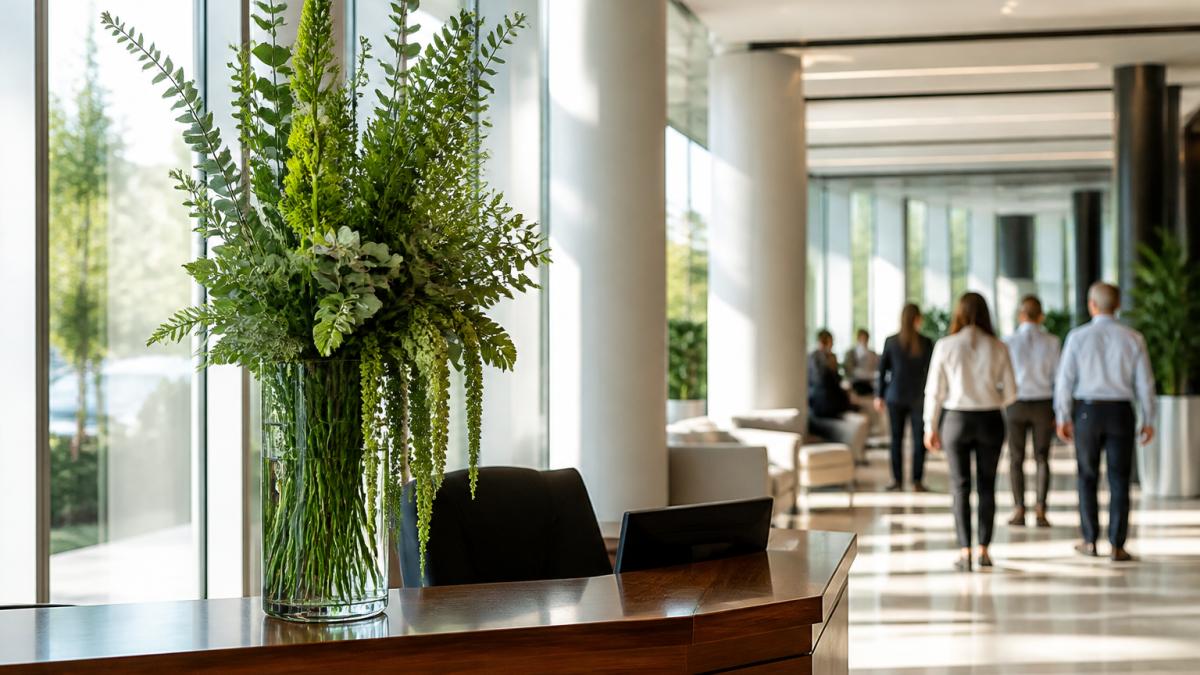
Monochromatic greenery arrangements add visual interest without introducing fragrance or high maintenance, using varying shades and textures of green foliage to create depth and sophistication.
Eucalyptus, ruscus, and Italian ruscus combine beautifully in monochromatic schemes; varying leaf sizes and subtle color shifts create movement without blooms, and these arrangements last significantly longer than mixed floral displays.
They also suit shared spaces where fragrance sensitivity is a concern, open offices, meeting rooms, or areas near employee workstations where strong floral scents could create discomfort.
Monochromatic greenery arrangements last 2-3 weeks with minimal care. A simple weekly water top-up is all they need to maintain their visual impact.
Seasonal Color Palettes
The seasonal approach also aligns with availability and cost: tulips and hyacinths in spring, garden roses in summer, chrysanthemums and dahlias in fall, and amaryllis in winter all look their best in season while reducing the environmental impact of shipping out-of-season blooms.
Rotating seasonal arrangements signals to clients and employees that your office is alive and intentional, a subtle but powerful detail that builds confidence in your organization.
Flowers for Office Reception Areas That Welcome Clients
Reception areas set the tone for client interactions, communicating professionalism, attention to detail, and stability. This is where corporate office floral decor makes its strongest first impression.
Large-scale arrangements work best in reception spaces because they create an immediate visual anchor.
Orchids remain the gold standard for reception areas because they signal luxury and longevity.
Roses and hydrangeas also work beautifully in reception settings, both projecting stability and professionalism: hydrangeas offer volume and presence, while roses provide a more refined aesthetic.
Law firms, financial institutions, and corporate headquarters benefit most from orchid-based reception arrangements. These settings benefit from flowers that communicate precision, reliability, and established expertise.
Low-Maintenance Office Plants and Flowers for Busy Teams
Most office environments aren’t ideal for high-maintenance florals; limited natural light, inconsistent watering, and temperature fluctuations challenge traditional cut flowers, but low-maintenance options thrive in these conditions.
Orchids: Elegance with Minimal Care
Orchids deserve their reputation as low-maintenance office plants: water once weekly, indirect light, and 8-12 weeks of bloom when properly placed.
Placement is key: east- or north-facing windows provide ideal light without harsh afternoon sun that can damage leaves, and orchids still perform well under standard office fluorescent lighting; they’re remarkably adaptable.
Peace Lilies and Succulents
Peace lilies thrive in low light, making them ideal for interior offices without windows.
Succulents are the ultimate low-maintenance option: echeveria, jade plants, and aloe tolerate irregular watering and poor light, working beautifully on desks, shelves, and windowsills. Their geometric shapes complement modern office aesthetics with virtually no care.
The downside is their lack of traditional floral impact; they suit desk displays or accent plantings rather than statement arrangements, but their durability makes them practical where regular maintenance isn’t feasible.
Corporate Event Floral Decorations for Meetings and Launches
Corporate events demand floral decorations that enhance the space without overwhelming it or creating maintenance headaches. Event florals create atmosphere and reinforce your brand message, but only if planned around the room, the audience, and the schedule. Coordinating these botanical arrangements with modern wall decor ensures a cohesive visual identity that anchors the entire environment throughout the duration of your gathering.
Scaling to the Venue and Sightlines
Stage arrangements and backdrop florals should be proportional to the venue; a 500-person conference needs larger-scale arrangements than a 50-person meeting, and visible from the back of the room without dominating the stage or blocking sightlines.
For product launches, florals can reinforce brand colors and messaging: sleek, minimalist arrangements for a tech launch, dramatic high-impact designs for a luxury brand, but they should never compete with the product or the presentation.
Scent, Allergies, and Enclosed Spaces
Avoid heavily scented flowers in enclosed event spaces; intensely fragrant lilies or gardenias overwhelm a room full of guests. Choose lightly scented or unscented blooms like roses, orchids, and hydrangeas; remove stamens from lilies and prefer double-flowered varieties where pollen is a concern. If guests have known sensitivities, place scented arrangements near entrances or transition areas rather than at dining tables or in small meeting rooms.
Timing, Delivery, and On-Site Care
Timing matters: arrangements delivered the morning of an event are fresher than those prepared days in advance. Build a delivery window that leaves time for setup and a final check, and confirm who on-site will top up water and remove spent blooms. For multi-day conferences, plan a mid-event refresh, swapping water and removing tired blooms, rather than replacing entire arrangements.
Safety and Logistics
Event florals introduce trip and spill risks: keep arrangements out of walkways, away from power cables and AV equipment, and secured on stable bases in high-traffic areas. Use waterproof liners on tables, avoid heavy shedders on walkable floors, and for outdoor or tented events, weight bases against wind and choose materials that tolerate temperature swings.
Confirm venue rules before ordering. Many venues restrict open flames, hanging installations, and certain adhesives, and some require florals to be removed the same night. Build these constraints into your plan rather than discovering them during setup.
This is where local floral expertise becomes invaluable. A florist who knows the venue can coordinate delivery timing, recommend arrangements that suit the room’s light and airflow, and provide on-site support so arrangements peak during your event rather than before it.
Desk and Workspace Floral Displays
Individual desk arrangements create personal touches within professional environments, but they fail when they ignore a workstation’s physical realities. A display that crowds a keyboard, blocks a monitor, or drips onto a laptop is worse than none at all, so the best desk florals are designed around the desk’s constraints.
Sizing and Placement Around Equipment
A 15-20 cm arrangement works well for most desks, but placement matters more: keep it at least 15 cm from monitor edges and on the side opposite the dominant hand to avoid knocks during mouse work.
Account for HVAC airflow: desks under or beside ceiling vents dry out cut flowers faster, so use hardier materials like succulents and preserved botanicals or check water more often. Near windows, strong afternoon sun wilts delicate blooms, so rotate the arrangement weekly so one side doesn’t bleach.
Spill Risk and Desk-Safe Mechanics
Electronics and water don’t mix: use waterproof saucers or liner inserts under every desk arrangement and prefer weighted, low-center-of-gravity vessels over tall, narrow vases that tip when bumped. For hot-desking, use foam-free mechanics in a sealed container or a self-watering insert so the arrangement moves without leaking, and avoid trailing vines near keyboards and power strips.
Care That Fits a Workday
Desk arrangements should last at least 7-10 days: chrysanthemums, carnations, alstroemeria, and sturdy greenery like ruscus hold up well. Top up water every two to three days, re-trim stems once mid-cycle, and remove spent blooms promptly. For teams without a designated caretaker, a small preserved or dried arrangement eliminates watering entirely.
If desks are cleaned by facilities staff, label arrangements with a small care card so cleaning crews don’t move or discard them. A common pattern is to place desk florals on a fixed tray that stays in position during cleaning.
Desk arrangements also recognize employee contributions or celebrate team milestones, boosting morale in ways generic office décor cannot, provided they don’t become a maintenance burden or a hazard.
Choose desk flowers that complement the workspace aesthetic: simple, clean arrangements for minimalist offices, more expressive, colorful designs for creative spaces. The arrangement should feel intentional rather than an afterthought.
Practical Care and Accessibility Considerations
The most beautiful arrangement fails if nobody can maintain it or if it creates discomfort for occupants. Practical considerations determine whether your corporate office floral decor succeeds long-term.
Managing Fragrance and Allergies
Fragrance sensitivity affects more employees than you might realize; strong floral scents can trigger headaches, respiratory issues, or allergic reactions, which is where unscented or lightly scented flowers become essential.
Roses, orchids, and hydrangeas offer visual impact with minimal fragrance, while lilies, gardenias, and tuberose produce strong scents that can overwhelm shared spaces.
Pollen can also trigger allergies: removing stamens from lilies reduces it significantly, and double-flowered varieties (peonies, roses, dahlias) produce less pollen than single-flowered forms because they lack visible stamens.
Safe Placement and Watering
Placement affects both safety and maintenance: never obstruct emergency exits or create tripping hazards, and avoid tall arrangements on desks that block sightlines during important meetings.
Watering logistics matter more than most people realize: if an arrangement sits on a credenza or shelf, ensure water won’t drip onto electronics, documents, or carpet.
In high-traffic areas, secure arrangements so they won’t tip if bumped; a heavy vase on a stable base beats a tall, narrow arrangement on a wobbly stand.
Sustainable and Locally Sourced Floral Choices
Sustainability considerations increasingly influence corporate purchasing decisions. Choosing locally sourced flowers reduces transportation emissions and supports regional growers.
Dried flowers and preserved botanicals offer another sustainable option, lasting months or years and reducing replacements, ideal where fresh flowers are impractical.
Reusable vases and containers also reduce waste; a florist who refreshes arrangements in existing vases rather than always supplying new containers aligns with corporate sustainability goals.


