


Table of Contents
- How to Choose Appropriate Funeral Flowers: A Step-by-Step Guide
- Funeral Flower Etiquette: What to Send and What to Avoid
- Types of Funeral Flower Arrangements: From Standing Sprays to Sympathy Baskets
- Funeral Flower Meanings: Choosing Blooms and Colors That Speak
- When to Send Funeral Flowers: Timing, Delivery, and Venue Coordination
- How to Select Funeral Flowers Based on Relationship to the Deceased
- Funeral Flowers When the Family Requests Donations or No Flowers
- Conclusion
- Frequently Asked Questions
Last Updated: October 15, 2026
How to Choose Appropriate Funeral Flowers: A Step-by-Step Guide
Choosing appropriate funeral flowers starts with three questions: who are you sending to, where is the service, and what does the family want.
Funeral flowers are a floral tribute sent to a funeral, viewing, or memorial service to express condolences and honor the person who died.
Step 1: Confirm the family’s wishes first. Before you look at a single arrangement, check the obituary or ask the funeral director whether the family has requested flowers, donations, or nothing at all.
Step 2: Decide who the flowers are from. A tribute from a spouse or parent carries different weight than one from a coworker or a distant friend.
Step 3: Match the arrangement to the service type. A church service, a graveside gathering, and a celebration of life all call for different formats.
Step 4: Pick colors and blooms with meaning. White is the safest and most traditional choice. Beyond that, color carries its own message.
Step 5: Sort out timing and delivery. Flowers need to arrive before the viewing or service, not during it.
Step 6: Set your budget honestly. Pricing depends on arrangement size, flower variety, and delivery distance.
The table below maps the whole decision at a glance:
| Your situation | Arrangement to send | Typical placement |
|---|---|---|
| Spouse, parent, or child | Large standing spray or casket spray | Beside the casket or at the front |
| Sibling, close friend | Standing spray or wreath | On an easel near the service |
| Coworker or acquaintance | Sympathy basket or bouquet | Sent to the home or funeral home |
| Cannot attend the service | Bouquet delivered to the family home | Family’s kitchen or entryway |
Canadian funeral and bereavement consumer guidance
That is the short version. The rest of this guide explains each step in detail, including the etiquette rules people worry about most.
Funeral Flower Etiquette: What to Send and What to Avoid
Funeral flower etiquette is simple in principle: send something that supports the family rather than adding a task to their plate. The rules below cover what to send, what to avoid, and how to handle the awkward cases.
- Do check the obituary for a “donations in lieu of flowers” line before ordering.
- Do include a short, handwritten card. Keep it to two or three sentences.
- Do put the family’s religion and customs ahead of your own preference.
- Don’t send anything with a strong scent to a service held in a small room.
- Don’t choose bright, festive colors for a traditional service unless you know the family wants a celebration tone.
- Don’t send flowers to the funeral home if the family asked for donations only.
What you write on the card matters as much as the flowers. Avoid explaining the death back to the family or offering long personal memories. A simple “Thinking of you and your family” does more than a paragraph.
A common mistake is ordering the biggest arrangement you can afford. In practice, a well-chosen sympathy basket that fits the family’s wishes reads as more thoughtful than an oversized spray that crowds the service.
Sending flowers after the family has requested donations is not a generous gesture. It puts them in the position of having to acknowledge a gift they did not want. Check the obituary first.
Types of Funeral Flower Arrangements: From Standing Sprays to Sympathy Baskets
The main types of funeral flower arrangements are standing sprays, wreaths, casket sprays, sympathy baskets, and bouquets. Each one serves a different purpose and a different spot at the service.
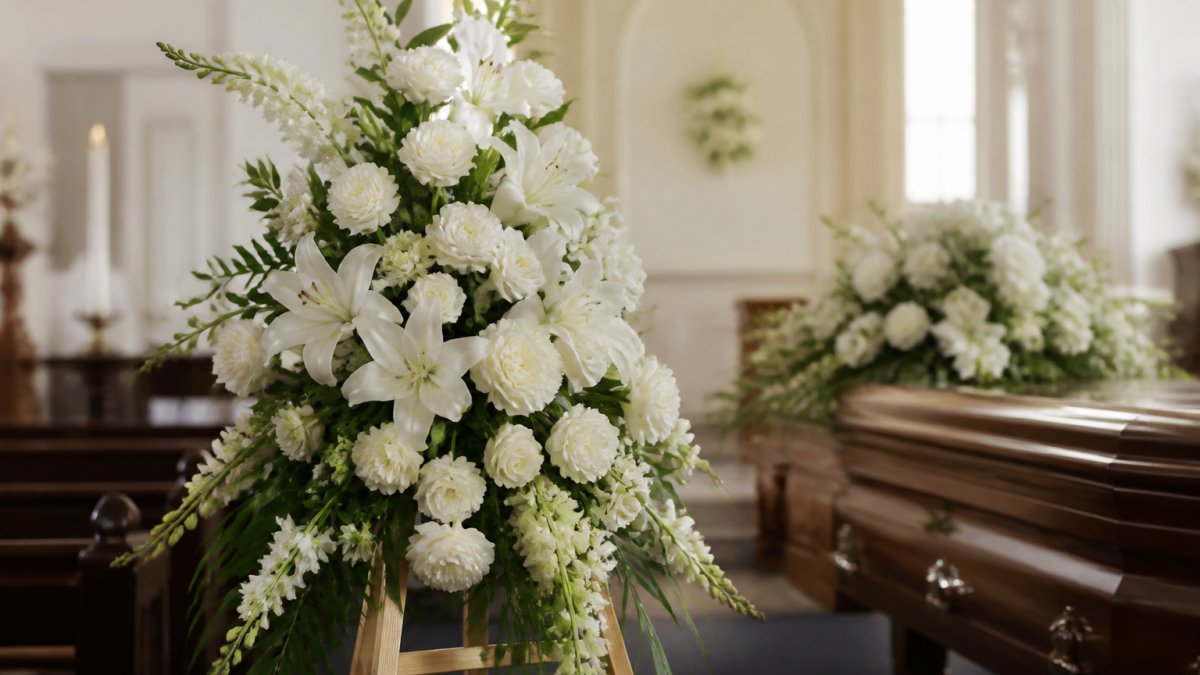
Standing sprays are large arrangements on an easel. They stand at the front of the service, near the casket, and they are usually sent by immediate family and close friends.
Wreaths are circular arrangements, also displayed on an easel. The circle traditionally represents eternal life. Wreaths suit both religious and non-religious services.
Casket sprays, sometimes called coffin flowers, rest on top of the casket itself. These come from the immediate family, so do not order one unless you are part of that inner circle.
Sympathy baskets and bouquets are the practical choice for coworkers, acquaintances, and anyone sending to the family home. They fit on a table, they travel well, and they do not compete with the family’s own tributes.
| Arrangement | Who usually sends it | Where it goes |
|---|---|---|
| Standing spray | Family, close friends | On an easel at the front |
| Wreath | Family, colleagues, organizations | On an easel near the entrance |
| Casket spray | Immediate family only | On the casket |
| Sympathy basket | Coworkers, acquaintances, neighbors | Family home or funeral home |
| Bouquet | Anyone, especially if not attending | Family home |
If you are unsure which one fits, ask the funeral director. They coordinate tributes every day and can tell you what the family already has.
Funeral Flower Meanings: Choosing Blooms and Colors That Speak
Funeral flower meanings give you a quiet way to say something specific. White flowers signal purity, innocence, and reverence. Red roses express love and grief. Pink blooms suggest gentleness and remembrance.
The blooms below are the ones we work with most often for sympathy arrangements:
- Lilies represent the return of the soul to innocence. White lilies are the classic funeral flower.
- Roses carry love and respect. White roses suit any service; red roses are for a spouse or partner.
- Carnations symbolize remembrance and admiration. They hold up well in long services.
- Chrysanthemums are widely used in many cultural traditions to honor the deceased.
- Orchids suggest lasting love and strength. They suit a celebration of life well.
- Gladioli represent strength of character and sincerity.
Color matters just as much as the bloom. White is the safest choice across nearly every tradition. Purple suggests dignity and spirituality. Yellow, once associated with friendship, now often reads as a celebration of a life lived. Deep red is reserved for close loved ones.
If you cannot decide between two arrangements, choose the one with more white and green. White flowers and foliage blend with any tribute already at the service.
If the person who died had a favorite flower, that detail often matters more to the family than tradition. Mention it when you order and we can build the arrangement around it.
When to Send Funeral Flowers: Timing, Delivery, and Venue Coordination
Funeral flowers should arrive before the viewing or service begins, ideally the day before or the morning of. Late arrivals get placed in a back room, where the family may never see them.
Timing is where most orders go wrong. A few rules keep it simple:
- Send to the funeral home for the viewing or service, and to the family home if you are not attending.
- Order at least one day ahead when you can, especially for a standing spray or wreath.
- For a church service, confirm whether the church accepts deliveries and when.
- For a graveside service, send to the funeral home, which coordinates transport to the cemetery.
- Give the full name of the deceased when ordering. The funeral home uses it to place your tribute correctly.
Same-day delivery is possible in many cases, but it depends on the time you order. Ordering early in the day gives you the best chance.
The single most useful thing you can do is give the florist the deceased’s full name and the venue address. That one detail lets the florist and the funeral director place your tribute correctly without involving the family.
How to Select Funeral Flowers Based on Relationship to the Deceased
The relationship to the deceased decides the scale of your tribute. Close family send large, formal pieces. Friends, coworkers, and neighbors send something smaller and warmer.
Use this decision tree:
- Spouse, parent, or child: A large standing spray or a casket spray. This is the family’s own tribute.
- Sibling or close friend: A standing spray or wreath on an easel.
- Extended family or colleague: A sympathy basket or a generous bouquet.
- Acquaintance or business contact: A modest bouquet sent to the family home.
- Someone who cannot attend: A bouquet delivered to the home, with a card.
There is no rule that says you must spend a set amount. What most guides miss is that a smaller arrangement chosen with care can be just as thoughtful as a large one. If you are sending on behalf of a group, such as a workplace, pool your budget into one good arrangement rather than several small ones. One tribute with twenty names on the card reads as more respectful than twenty separate deliveries.
Funeral Flowers When the Family Requests Donations or No Flowers
When a family requests donations instead of flowers, respect that request. Send a donation to the named charity, or send a sympathy card to the family. Do not send flowers anyway.
This is the case that trips people up most. A donation request is not a rejection of flowers. It is the family telling you what would help them most, often because the charity mattered to the person who died.
If you still want to send something, a card is always welcome. Many families keep the cards they receive and read them months later. If you are close to the family and want to send flowers regardless, ask a family member privately rather than assuming.
The same applies when the family requests no flowers at all. Some families plan a private service or a celebration of life where flowers are not part of the plan. In that case, a donation, a meal, or practical help around the house does more than a delivery the family did not ask for.
Anyone who wants to show support but has been told the family prefers donations. A card and a donation to the named charity honors the request and still lets you express condolences.
Conclusion
Getting this wrong is a real worry, and the reason is simple: you are making a decision at a difficult time, and you want it to land well. The good news is that the family rarely remembers the exact blooms. They remember that you thought of them.
If you would rather not work through the details alone, Brampton Florist can help. We are a family-owned shop, open seven days a week, and our designers build sympathy arrangements by hand to suit the service, the family’s wishes, and your budget. We offer same-day delivery, with orders placed by 1 PM reaching their destination the same day, and reliable delivery across Brampton and surrounding areas. Order online or call and we will walk you through the right choice.
Frequently Asked Questions
What flowers are appropriate to send to a funeral?
Appropriate funeral flowers include lilies, roses, carnations, chrysanthemums, orchids, and gladioli. White flowers often symbolize purity and innocence, while other colors can reflect the deceased’s personality or cultural traditions. Consider the family’s wishes and any religious customs. A local florist can help you select a suitable arrangement, such as a standing spray or sympathy basket, that conveys respect and condolences.
What is the difference between funeral flowers and sympathy flowers?
Funeral flowers are typically sent to the service venue to decorate the ceremony, such as casket sprays, standing sprays, and wreaths. Sympathy flowers are sent to the family’s home or a designated location as a personal expression of condolences. Both serve to honor the deceased and comfort the bereaved, but their delivery timing and placement differ. Understanding this distinction helps you choose the right gesture.
When should funeral flowers be delivered?
Funeral flowers should be delivered to the funeral home or service venue at least 1-2 hours before the viewing or service begins. For home deliveries, send them within a few days after the death. If you’re unsure, coordinate with the funeral director or the family’s florist. Same-day delivery may be possible if you order by 1 PM, but always confirm timing.
Should I send flowers to the funeral or to the family’s home?
Send flowers to the funeral service if you want to honor the deceased publicly and contribute to the ceremony’s atmosphere. Send them to the family’s home if you prefer a more personal gesture of comfort that they can enjoy after the service. When in doubt, check the obituary for suggested locations or ask the funeral director. Both choices are appropriate and appreciated.
Choosing funeral flowers under time pressure is hard, and the last thing you need is a delivery that arrives late or an arrangement that clashes with the family’s wishes. Brampton Florist handles that part for you. Our designers hand-craft each sympathy arrangement, we deliver same-day when you order by 1 PM, and we are open seven days a week to answer questions before you buy. Get started with Brampton Florist and send a tribute the family will actually remember.


