


Last Updated: November 9, 2026
Quick Summary
Locally grown flowers are cut by nearby farms and harvested close to the event date, so they spend days rather than weeks in transit. Fresher stems open more slowly, hold their color longer, and often carry better fragrance and distinctive varieties. For events, this means tighter buds, more working days, and designs built around what is at its seasonal peak.
- Local stems are often harvested within a day or two of your event, while imported stems are cut considerably earlier.
- Contact growers at least one full season ahead for peak wedding months, such as January or February for a June wedding.
- Confirm harvest and delivery timing, ideally within 24 to 48 hours of the event.
- Set a decision deadline, often seven to ten days out, when the grower confirms what is coming.
- A stem at its natural peak is cheaper and better than the same stem forced or imported out of season.
Table of Contents
- Why Locally Grown Flowers Beat Imported Blooms for Events
- Freshness and Longer Vase Life
- Fragrance and Bloom Quality
- Seasonal Flower Availability Calendar: Plan Around Nature’s Seasons
- Distinctive Varieties and More Creative Floral Designs
- How to Source Local Flowers for Weddings and Other Events
- Longevity of Fresh-Cut Local Flowers: What to Expect
- Environmental Impact: Lower Carbon Emissions and Less Waste
- Budget, Pricing, and Contingency Planning for Local Blooms
- Support Local Flower Farmers and the Local Economy
- Frequently Asked Questions
Why Locally Grown Flowers Beat Imported Blooms for Events
Locally grown flowers are cut flowers cultivated by nearby farms and harvested close to the event date, which means they spend days rather than weeks in transit. Locally grown stems are often harvested closer to the event date, which can mean tighter buds and more working days ahead of them.
The core argument is simple. Imported flowers are bred to survive a supply chain. Local flowers are grown to look and smell beautiful on the day. Those are different goals, and they produce visibly different results.
Freshness and Longer Vase Life
Freshness is the single biggest advantage of locally grown flowers. A local stem is often harvested within a day or two of your event, while an imported stem may be cut considerably earlier and then cooled, packed, flown, and trucked before it reaches a designer.
That gap changes everything downstream. Fresher stems open more slowly, hold their color longer, and recover better from the handling that any event arrangement goes through.
If freshness is your priority, our guide on 7 reasons local florist arrangements last longer explains the handling side in more depth.
Fragrance and Bloom Quality
Scent is where local flowers quietly win. Local growers can choose varieties for fragrance, since the blooms do not face a long journey.
Bloom quality follows the same logic.
Seasonal Flower Availability Calendar: Plan Around Nature’s Seasons
A seasonal flower availability calendar is a planning tool that maps which blooms a local grower can supply month by month, so you design around what is at its peak rather than against it. Planning around nature’s seasons can help you choose flowers that are at their best.
Here is how the year generally breaks down for local growers:
- Spring: tulips, daffodils, ranunculus, peonies arriving late in the season
- Early summer: peonies at their peak, sweet peas, snapdragons, first roses
- High summer: dahlias, zinnias, sunflowers, lavender, gladiolus
- Autumn: dahlias finishing, chrysanthemums, hydrangeas, dried flower work
- Winter: evergreens, amaryllis, forced bulbs, imported staples filling gaps
The practical takeaway: pick your date first, then let the season shape the palette. A dahlia-heavy design in February means imports. The same design in August is entirely local.
Here is how the year generally breaks down for local growers.
| Season | What local growers supply |
|---|---|
| Spring | Tulips, daffodils, ranunculus, peonies arriving late in the season |
| Early summer | Peonies at their peak, sweet peas, snapdragons, first roses |
| High summer | Dahlias, zinnias, sunflowers, lavender, gladiolus |
| Autumn | Dahlias finishing, chrysanthemums, hydrangeas, dried flower work |
| Winter | Evergreens, amaryllis, forced bulbs, imported staples filling gaps |
Distinctive Varieties and More Creative Floral Designs
Local growers may plant varieties that larger supply chains do not carry, which can mean unusual colors and shapes for event work.
A local grower may be able to work toward a specific palette, so it is worth discussing your brief with them directly.
For inspiration on what distinctive arrangements can look like at a corporate or celebratory event, browse our corporate office floral decor ideas. They show how far a considered palette can stretch.
How to Source Local Flowers for Weddings and Other Events
Sourcing local flowers for a wedding or event generally means booking a grower early and building a delivery plan that protects the blooms on the day. Your florist may be able to help with farm relationships.
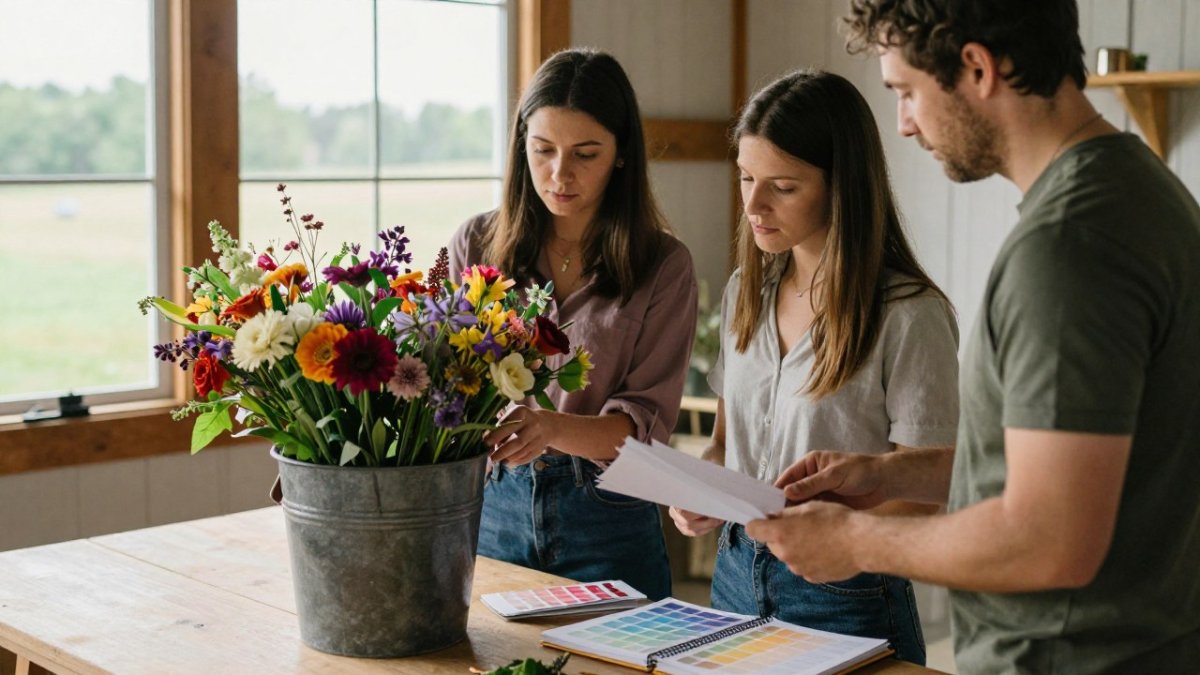
If you are sourcing directly, work in this order:
- Set your date and venue, then confirm whether the venue allows open flames, hanging installations, or outdoor setup time.
- Contact growers at least one full season ahead for peak wedding months. For a June wedding, that means reaching out by January or February; for a September event, by March or April.
- Agree on a color direction and a backup palette, not exact stem counts. Growers commit more reliably to a palette than to a precise number of stems.
- Confirm harvest and delivery timing, ideally within 24 to 48 hours of the event. Ask whether the grower delivers or whether you collect, and who is responsible for conditioning on arrival.
- Plan conditioning space: cool, shaded, and out of direct sun. Most venues can offer a back room or a shaded loading area, but confirm access times in writing.
Outdoor venues add their own logistics. Our planning guide on wedding flower delivery for outdoor venues walks through timing and setup for open-air ceremonies.
A Practical Sourcing Timeline
A common pattern among event florists is to work backward from the event date:
- Six to nine months out: book the grower and agree on the seasonal palette. Peak wedding months fill first.
- Three months out: confirm the color direction, the backup palette, and the approximate stem count by arrangement type.
- Four to six weeks out: finalize quantities, confirm delivery windows, and lock in the contingency plan.
- One to two weeks out: reconfirm harvest timing and delivery logistics, and share any venue access restrictions.
- Two to three days out: receive and condition the stems, and check that the blooms are opening on schedule.
Watch out: leaving the final count until the week of the event often means the grower has already committed the best stems elsewhere, so the backup palette becomes the main palette.
Questions to Ask a Local Flower Farmer
- What is at its peak on my date, and what is a realistic backup?
- How close to the event will the flowers be harvested?
- What quantities can you commit to, and when do you need the final count?
- How are the stems conditioned and delivered?
- What happens if weather or crop loss affects my order?
That last question matters more than most couples expect. A good grower answers it without hesitation and can name the specific backup varieties they would substitute.
Longevity of Fresh-Cut Local Flowers: What to Expect
Vase life varies by flower type and handling, and fresh-cut flowers generally last for several days in a clean vase with regular water changes. Exact vase life depends on the species, the harvest stage, and how the stems are handled after the event.
The variables that matter most:
- Harvest stage: buds cut at the right moment open in your space, not in a box.
- Conditioning: clean cuts, stripped lower leaves, and cool water before design.
- Home care: fresh water every two days, a cool spot, and away from direct sun and fruit.
- Species: dahlias and poppies are short-lived; chrysanthemums and carnations run long.
For a full care routine you can hand to clients or keep for yourself, see how to make flowers last longer.
Environmental Impact: Lower Carbon Emissions and Less Waste
Local flowers can reduce transportation emissions and the waste that comes with long supply chains.
There is a second, quieter benefit: less packaging. Local bunches usually need less wrapping, sleeving, and chemical preservative to survive the trip. Fewer damaged stems also means less spoilage thrown out before an event.
We are careful not to overstate this. Local sourcing is one factor among several, and growing practices matter too. But when all else is equal, a shorter journey is a lighter one.
Budget, Pricing, and Contingency Planning for Local Blooms
Pricing for event flowers depends on quantity, dates, and delivery, so request a quote from Brampton Florist on our website or by phone rather than working from a fixed list.
The main cost drivers to understand before you set a budget:
- Season: a stem at its natural peak is cheaper and better than the same stem forced or imported out of season. A dahlia-heavy design in February means imports and a higher price; the same design in August is entirely local and more economical.
- Variety: specialty and heirloom varieties cost more to grow and yield fewer stems per plant than high-volume commercial varieties. If a specific unusual bloom is the centerpiece of your design, expect it to carry a premium.
- Labor: locally grown stems often need more conditioning and design time because they arrive in natural, varied forms rather than uniform wholesale bunches. That labor is part of the quote.
- Transport and delivery: local delivery is usually a short regional trip, but it is still a line item. Confirm whether delivery, setup, and breakdown are included.
- Peak dates: wedding season and holiday weeks raise prices across the board, local or imported. Booking early protects both availability and price.
Three budget habits that help:
- Design with the season. In-season stems stretch a budget further than fighting the calendar.
- Spend on focal points. Put the statement blooms where guests look: arbor, head table, entrance.
- Build a contingency line. Weather and crop variability are real. A backup palette and a small reserve protect the design if a crop underdelivers.
Contingency Planning for Weather and Crop Variability
Flowers are agricultural products, and weather or pests can affect specific crops. A workable contingency plan has three parts:
- A backup palette, not a backup flower. Agree with the grower on two or three substitute varieties that share the same color and texture role, so a substitution does not change the design.
- A quantity buffer. For hero arrangements, plan a small reserve of stems so a shortfall in one variety does not leave a gap.
- A decision deadline. Set a date, often seven to ten days out, when the grower confirms what is coming, and you decide whether to substitute or supplement.
Many florists blend sources, and it is worth asking directly about what you will receive. Watch out: a quote that assumes every stem will be local can leave you paying a premium for last-minute imports if a crop underdelivers, so ask how substitutions are priced before you sign.
Support Local Flower Farmers and the Local Economy
Buying from local growers can help keep money in the region and support local farmland.
Local, chemical-conscious growing also tends to favor natural pest management. If you grow roses yourself, our guide on controlling pests on rose bushes naturally covers the same approach growers use.
Planning an event means juggling dates, venues, and a hundred small decisions. Let us take the flowers off that list. Brampton Florist is family owned and operated, open seven days a week, with same-day delivery available on orders placed by 1 PM.
Frequently Asked Questions
Are locally grown flowers more expensive than imported ones?
Not necessarily. In-season local flowers often cost less than imported blooms because they skip air freight and long cold-chain storage. Out-of-season requests can cost more since a local grower may not have them at all. Pricing depends on quantity, dates, and delivery, so ask your florist for a quote based on your event date and colour palette rather than comparing headline prices.
How do local flowers compare in quality and longevity to imported varieties?
Locally grown flowers are often cut closer to your event, which can help them keep their vase life. Expect local blooms to hold up well across a full event day and the days after, provided they are conditioned properly and kept out of direct heat and sun.
How can I find local flower farms for my event?
Start with a full-service local florist, since they can handle sourcing, conditioning, and design in one place. Ask which growers they work with and whether the blooms are seasonal. If you want to buy direct, farmers’ markets and grower listings are good starting points, but confirm delivery windows and whether the farm can handle event-scale quantities.
What are the environmental benefits of using locally grown flowers?
The main benefit is fewer transport emissions, since local blooms travel short distances by road instead of by air from distant growing regions. Choosing seasonal flowers further cuts the energy needed for heated greenhouse production and long cold storage.


