


Table of Contents
- Start Your Search Early: Timeline and Booking
- How to Find and Shortlist Wedding Florists
- Review Portfolio and Previous Wedding Work
- Questions to Ask a Wedding Florist During Consultation
- Wedding Florist Consultation Checklist and What to Bring
- Planning Your Wedding Flower Budget
- How to Choose Wedding Flowers by Season and Availability
- Contract Terms, Delivery, and Setup Requirements
- Frequently Asked Questions
Last Updated: October 7, 2026
Start Your Search Early: Timeline and Booking
Start choosing wedding florists six to twelve months before your wedding date. This gives you access to the best florists and time to plan without rushing.
Peak season runs May through October; book eight to twelve months ahead.
Top florists fill up fast, and early booking gives you more choice in design style and pricing, plus time to discuss seasonal availability and substitutions.
Contact your venue coordinator or wedding planner first. They often have preferred florist lists and can recommend professionals who know your venue’s layout, delivery access, and setup requirements.
How to Find and Shortlist Wedding Florists
Search online for florists near you, checking websites, Instagram, Google reviews, and wedding-specific sites. Shortlist five to eight.
When shortlisting, consider these factors:
- Portfolio quality: Do their past wedding arrangements match your style?
- Experience: How many weddings have they designed?
- Service area: Do they deliver to your venue?
- Communication: Do they respond promptly to inquiries?
- Specialization: Do they focus on weddings or handle all event types?
A good florist has a cohesive aesthetic. Wildly varied Instagram feeds may signal versatility rather than a distinct vision, fine for flexibility but less ideal for a specific look.
Narrow your list to three or four florists. These are the ones you’ll contact for consultations.
Your shortlist should include florists whose past work genuinely excites you. Don’t settle for “good enough”, your wedding flowers deserve a designer whose style matches your vision.
Review Portfolio and Previous Wedding Work
Ask for their portfolio and review wedding work specifically, not general arrangements. Look for:
- Bridal bouquets and bridesmaid arrangements in your preferred style
- Ceremony flowers that match your venue type (church, garden, barn, etc.)
- Reception centerpieces and table flowers
- Color palettes you love
- Freshness and attention to detail in the photos
Ask how recent the images are; photos from the last year or two reflect current skill.
Request references from past wedding clients and ask them:
- Did the flowers arrive fresh and on time?
- Did the final arrangements match the consultation vision?
- How did the florist handle last-minute changes?
- Would they hire this florist again?
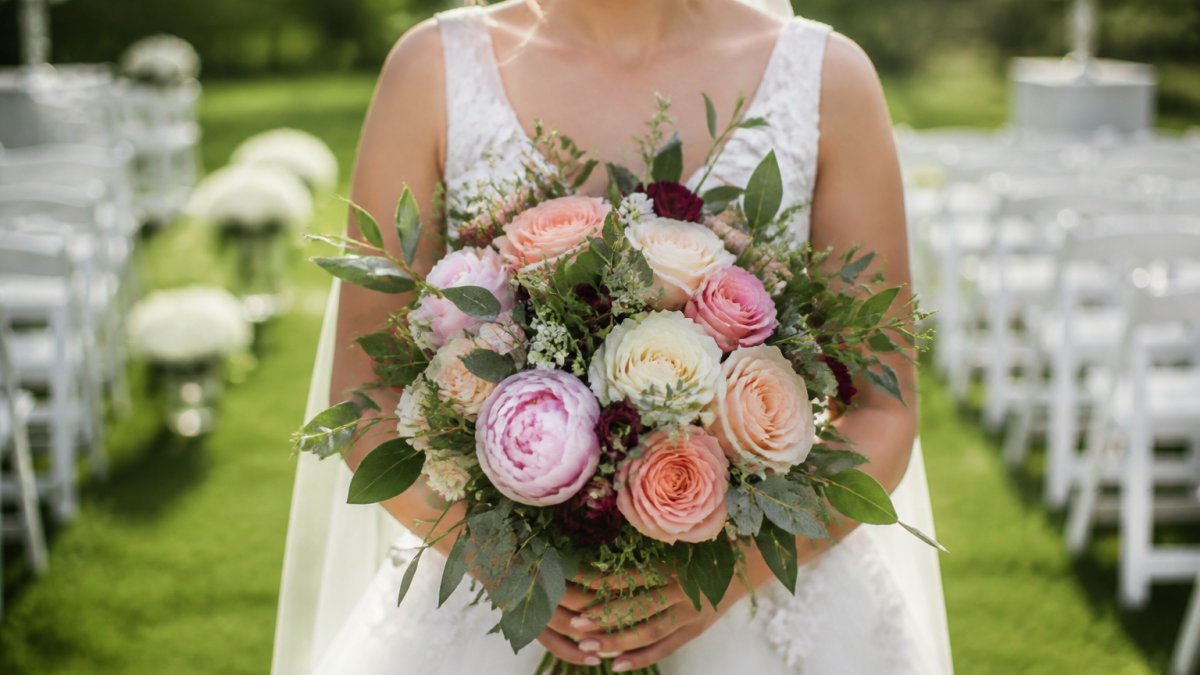
Note how they present their work: professionals explain design choices and document multiple angles and lighting conditions.
Questions to Ask a Wedding Florist During Consultation
Come prepared. Ask these questions:
About Their Design Process:
- How do you approach wedding floral design?
- How do you translate a couple’s vision into reality?
- What’s your design style, and how flexible are you?
About Your Specific Wedding:
- Have you worked with our venue before?
- What are your recommendations for our wedding date and season?
- What flowers are typically available at our wedding date?
- Will you need to substitute any flowers, and how do you handle that?
About the Arrangements:
- How many bridesmaids bouquets do we need?
- What about boutonnieres and corsages?
- How many centerpieces for the reception?
- Will you provide ceremony flowers (arch, aisle, altar)?
- What about cocktail hour arrangements?
About Logistics:
- When will you deliver the flowers?
- Who sets up the arrangements at the venue?
- What’s the backup plan if flowers are damaged during transport?
- Do you provide rental items (vases, stands, containers)?
About Budget and Pricing:
- What’s included in your base pricing?
- How do you charge for add-ons?
- What’s your payment schedule and cancellation policy?
- Are there peak-season premiums?
A good florist answers thoroughly and asks detailed questions about your vision, budget, and constraints.
Wedding Florist Consultation Checklist and What to Bring
Bring these items to your consultation:
- Inspiration images: Collect 10-15 photos of bouquets, centerpieces, and wedding flowers you love. Use Pinterest, Instagram, or wedding magazines.
- Mood board: Organize your images by color, style, and theme.
- Wedding details: Your date, time, venue name, ceremony and reception locations, guest count, bridal party size, color scheme.
- Budget range: Know your total floral budget and priorities (which arrangements matter most).
- Venue information: Photos of your ceremony and reception spaces, venue coordinator contact, setup timeline.
During the consultation, the florist should:
- Review your inspiration images and mood board
- Ask detailed questions about your vision
- Discuss seasonal flower availability
- Suggest flowers and color combinations
- Explain design options and pricing
Take notes, ask for an emailed summary and preliminary quotes, and compare proposals from all shortlisted florists before deciding.
If a florist dismisses your ideas or pushes you toward their preferred style without discussion, that’s a red flag. A good florist collaborates with you, even if they gently guide you toward what works best.
Planning Your Wedding Flower Budget
Your floral budget depends on guest count, arrangement complexity, stem choice, and season. Most couples spend 8% to 12% of their total wedding budget, though that share rises for those treating flowers as a design centerpiece.
The cost drivers that actually move your total
- Stem count and bloom size: A centerpiece built from 40 garden roses costs far more than one built from 12 dahlias and a base of greenery. Ask your florist to quote by stem count, not just by “small, medium, large.”
- Arrangement count: This is the single biggest lever. Ten tables versus twenty tables doubles your centerpiece line almost linearly.
- Flower type: Peonies, garden roses, and orchids carry premium pricing. Carnations, chrysanthemums, alstroemeria, and seasonal field flowers deliver similar visual mass at a fraction of the cost.
- Season and date: Peak-season Saturdays command the highest pricing. Off-season dates, Fridays, and Sundays often unlock meaningful savings on the same design.
- Labor and installation: A simple drop-off of bouquets costs far less than a full arch install with on-site labor, rigging, and teardown.
A practical allocation framework
Split your total floral budget into tiers. A common pattern:
- Personal flowers (bouquets, boutonnieres, corsages, flower crowns): 15-25% of the floral budget. The bridal bouquet is usually the single most expensive arrangement because it is photographed more than any other piece.
- Ceremony flowers (arch, aisle, altar, entry): 10-20%. These are seen for a short window, so many couples reuse ceremony pieces at the reception.
- Reception centerpieces: 30-45%. Quantity drives this line more than any other.
- Statement and accent pieces (escort table, cake table, bar, restrooms, cocktail hour): 10-20%.
- Rentals, delivery, setup, and labor: 10-15%. Often overlooked, and often the line that surprises couples.
How to stretch the budget without losing the look
- Repurpose ceremony flowers at the reception. Move arch and aisle pieces to the head table, bar, or entryway. This is the highest-return move available.
- Go greenery-heavy. Foliage delivers volume and texture at a lower cost per square foot than blooms.
- Concentrate, don’t spread. Two dramatic arrangements beat eight forgettable ones. Guests remember focal points, not uniformity.
- Choose in-season and locally grown stems. They are typically fresher, less expensive, and less prone to substitution.
- Reduce table count or seat more guests per table. Fewer, larger tables mean fewer centerpieces.
What to ask for in the proposal
Request a line-item quote separating product from labor, including each arrangement, delivery, setup, teardown, and rentals. This lets you compare florists fairly and trim scope later without renegotiating.
Ask your florist to quote a “priority tier” and a “trim tier” for the same design. Seeing both versions side by side makes it obvious which elements you actually care about and which you were only including out of habit.
Understand payment terms before committing: most florists require a non-refundable deposit with the balance due before delivery. Ask whether the deposit applies to the final total, whether taxes and delivery are included, and whether peak-season surcharges apply.
How to Choose Wedding Flowers by Season and Availability
Seasonal flowers are fresher, cheaper, and more sustainable.
Spring flowers (March-May): tulips, peonies, ranunculus, hyacinths, lilacs, bleeding heart, garden roses.
Summer flowers (June-August): roses, dahlias, zinnias, sunflowers, lavender, delphiniums, hydrangeas.
Fall flowers (September-November): chrysanthemums, dahlias, celosia, solidago, hypericum berries, ornamental grasses.
Winter flowers (December-February): roses, amaryllis, hellebores, hypericum berries, evergreen foliage, branches.
Discuss substitutions: a good florist has backup options matching your vision.
Contract Terms, Delivery, and Setup Requirements
Review the contract carefully before booking. Key terms:
Booking deposit: Most florists require a deposit to hold your date. This is typically 25-50% of the estimated total. Know the deadline for paying the balance and whether the deposit is refundable or applied to the final invoice.
Payment schedule: When is the remaining balance due? Usually it is due before delivery or on the wedding day.
Cancellation and rescheduling policy: What happens if you cancel? Can you reschedule instead?
Change deadlines: When is the final headcount and final arrangement count due?
Substitution clause: What happens if a key flower becomes unavailable?
Liability and damage: What if flowers arrive damaged, or an arrangement wilts during the reception?
Venue-specific logistics most couples overlook
Delivery and setup are where weddings go sideways. Confirm these details with both the florist and the venue coordinator in writing:
- Access windows: Many venues allow vendors in only during a narrow window, often two to four hours before the ceremony. Ask the venue for the exact load-in and load-out times and share them with your florist.
- Loading access: Is there a loading dock, service elevator, or freight entrance? Are there stairs, narrow doorways, or low ceilings that limit large installations?
- Installation labor: Arch installs, hanging installations, and ceiling pieces often require rigging, ladders, and additional crew. Ask whether the quote includes the labor hours needed, not just the product.
- Power and water: Does the florist need access to water for hydration, or power for tools? Confirm what the venue provides.
- Teardown: Who removes the flowers after the event? Is teardown included, or is it billed hourly? Some venues require all decor removed the same night; others allow next-morning pickup.
- Venue restrictions: Some venues prohibit open flames, certain adhesives, floral foam, or attaching anything to walls and ceilings. Confirm restrictions before design is finalized.
Do not assume delivery and setup are included in the quoted price. Many florists quote product only and bill delivery, setup, and teardown separately. Get these lines in writing before you sign.
A practical way to compare proposals
When you have two or three proposals in hand, compare them line by line rather than by total. Look at stem counts, arrangement sizes, rental inclusions, delivery and setup fees, teardown terms, and substitution language. A lower total often reflects fewer stems, smaller arrangements, or excluded labor rather than a better deal.
The florist who gives you the most detailed written proposal, with clear delivery, setup, teardown, and substitution terms, is usually the one who will be easiest to work with on the wedding day.
Ask how they handle day-of coordination: will they be on-site during setup, and can you reach them if issues arise? A responsive florist who communicates clearly with your venue and vendors is invaluable.
Frequently Asked Questions
How far in advance should you book a wedding florist?
Most wedding florists recommend booking six to twelve months ahead, especially if your wedding falls during peak wedding season. Booking early ensures your preferred florist is available and allows time for detailed consultations and design planning. If you’re planning a smaller or off-season wedding, three to six months may be sufficient, but earlier is always better to secure your preferred florist and design team.
What questions should you ask a wedding florist?
Ask about their experience with your wedding style and venue, whether they’ve worked with your ceremony and reception locations before, their approach to seasonal flower availability and substitutions, delivery and setup fees, payment schedule and cancellation policies, and how they handle last-minute changes. Also inquire about their design process, whether they offer multiple proposal options, and how they source flowers, whether locally or seasonally. These questions help ensure the florist understands your vision and can deliver within your timeline and budget.
How much should you budget for wedding flowers?
Wedding flower budgets vary widely based on guest count, venue size, and floral complexity. Budget typically accounts for the bridal bouquet, bridesmaid bouquets, boutonnieres, corsages, ceremony flowers, reception centerpieces, and any additional decor. Pricing depends on quantity, dates, delivery, and design intricacy. Contact your florist directly for a detailed quote based on your specific needs. A consultation helps clarify what’s included and ensures the proposal aligns with your priorities and financial plan.
What is the best way to choose wedding flowers by season?
Seasonal flowers are fresher, more affordable, and more readily available. Spring offers tulips, peonies, and cherry blossoms; summer brings roses, sunflowers, and dahlias; fall features chrysanthemums, dahlias, and ranunculus; winter includes amaryllis, carnations, and evergreens. Work with your florist to identify which seasonal blooms match your color scheme and theme. They can suggest substitutions if a preferred flower isn’t available and recommend combinations that look stunning while maximizing freshness and value.


